

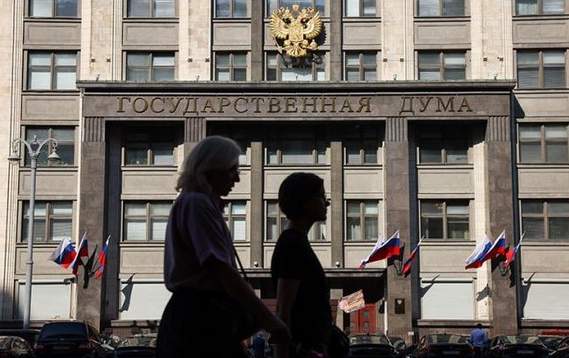
The Communist Party of the Russian Federation (KPRF) has criticised Russia’s electoral system following the decision of Irina Eliferova, a newly elected State Duma deputy from the ruling United Russia party, to relinquish her parliamentary mandate just one week after the new parliament began its work.
Image
"Such cases are commonplace, a consequence of United Russia's total monopoly, which can make any decision."
KPRF criticises Russia’s election system
In an interview with Svobodnaya Pressa, Sergei Obukhov, a member of the party’s Presidium and Secretary of its Central Committee, stated that the case illustrated the extent of the ruling party’s political dominance and the limited role of elections in determining the composition of government.
Eliferova was elected through United Russia’s federal party list after four of the five prominent figures heading the list declined their mandates: Foreign Minister Sergei Lavrov, Moscow Mayor Sergei Sobyanin, war correspondent Yevgeny Poddubny and presidential children’s rights commissioner Maria Lvova-Belova. Eliferova subsequently submitted her resignation, citing a move to another job, although the destination was not specified. The State Duma was expected to consider the resignation on 13 October.
Criticism of the “locomotive” system
Obukhov focused on the practice commonly described in Russia as parovoz (“locomotive”): prominent politicians, including governors and ministers, head party lists and attract votes but subsequently decline their parliamentary seats, allowing lower-ranked candidates to enter the legislature.
The KPRF opposes this practice, Obukhov said, arguing that it undermines the relationship between voters and the representatives they elect. He described the role of governors heading United Russia’s lists as a performance indicator for the regional administrative apparatus: their task is to secure the highest possible vote for the ruling party.
According to Obukhov, the elections therefore served less as a mechanism for changing political power than as a test of the administrative system’s ability to deliver the required result. He argued that the dominance of United Russia allowed the party to make such decisions with few effective political constraints.
KPRF challenges the official interpretation of the election results
Obukhov also disputed the official presentation of the September 2026 State Duma election results and defined the system as "a consequence of United Russia's total monopoly."
The article also cited an analysis by the Centre for Political Studies of the Communist Party of the Russian Federation (CIPKR), which estimated that the KPRF had achieved the lowest cost per vote among the parties examined. The party nevertheless argued that its electoral performance was constrained by unequal conditions, including three-day voting, electronic voting, restrictions on election observers and limited television access for opposition forces.
Obukhov said the KPRF had proposed legislative measures to address the “locomotive” system through its draft Electoral Code and other legislative initiatives. However, he argued that opposition parties faced difficulties reaching voters because channels of access to public information were restricted.
KPRF asseses that Russia’s electoral system favours the ruling party through administrative dominance and unequal campaign conditions. It frames Eliferova’s resignation not as an isolated personnel decision but as an example of a system in which prominent candidates can use their place on a party list to help secure votes without necessarily serving as deputies.
(Photo: Maxim Churusov / TASS)