
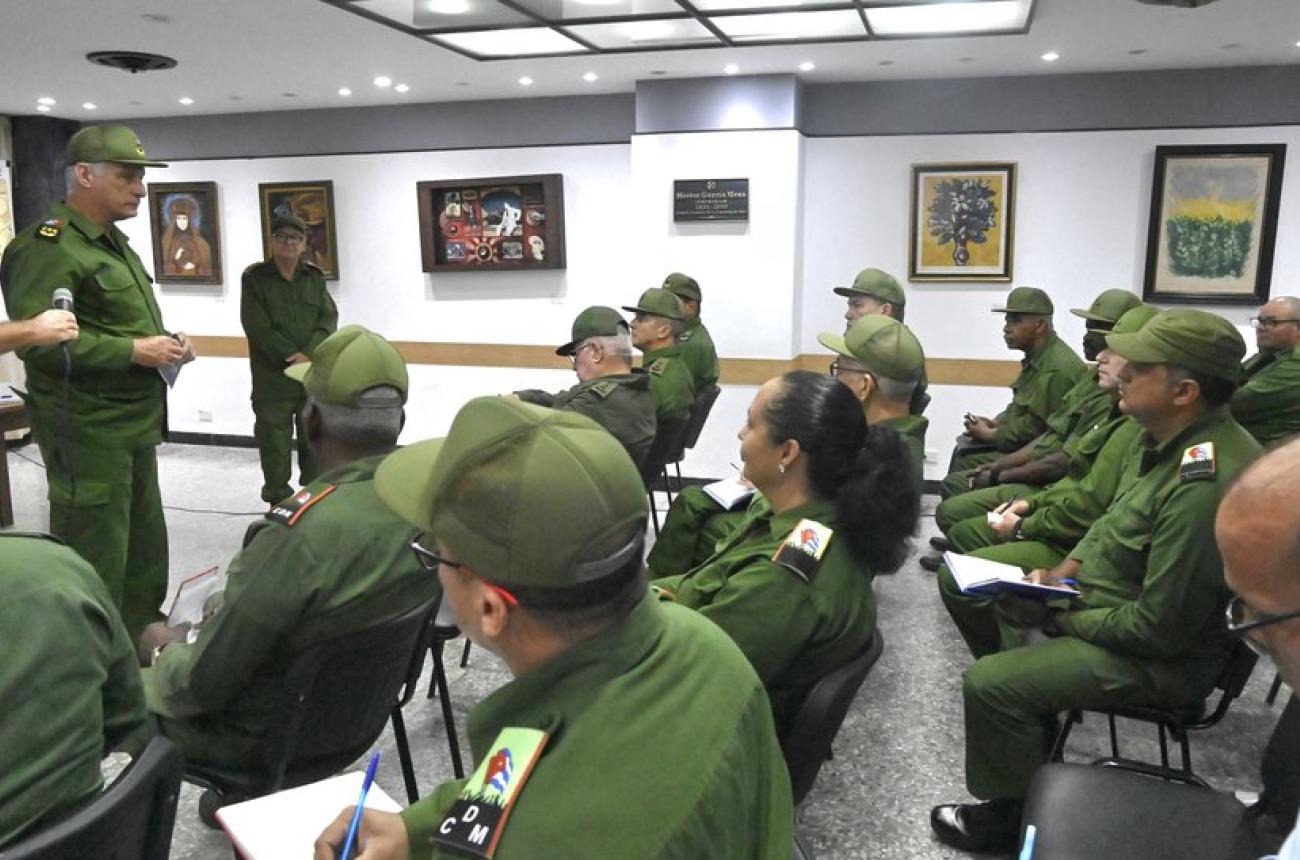

Cuban President and First Secretary of the Communist Party of Cuba, Miguel Díaz-Canel Bermúdez, visited the Colón Nuevo Vedado Zone Defense Council in Havana on Friday, 9 October, as part of activities marking National Defense Day.
Díaz-Canel reviews local defence preparations and community initiatives
He reviewed local preparations for national defence and initiatives addressing residents’ everyday needs.
The council oversees a territory of approximately two square kilometres, home to more than 15,000 people organised into 12 constituencies. Its preparations include 28 Production and Defence Brigades, a Territorial Troop Militia battalion, warning procedures, population protection measures and evacuation drills. Particular attention is being given to vulnerable residents, including older people, children, pregnant women and people with disabilities.
The visit also highlighted the council’s social and economic work. Initiatives include assistance for pensioners and vulnerable households, measures to improve water and electricity supplies, a new Family Care System facility providing meals, and a neighbourhood waste-collection project called Tricicliando en mi barrio. The area’s ageing population makes these services especially important, with roughly 40% of residents reported to be elderly.
The council’s president, Alexis Triana Hernández, who also heads the Cuban Institute of Cinematographic Art and Industry (ICAIC), described cooperation between state institutions and non-state economic actors in developing projects to address local problems. Díaz-Canel encouraged other Havana defence councils with similar urban characteristics to learn from these experiences.
The visit took place at ICAIC, near the historic intersection of 23rd and 12th streets, where Fidel Castro declared the socialist character of the Cuban Revolution on 16 April 1961. Díaz-Canel emphasised that national defence involves not only military preparedness but also the capacity to resolve community problems and maintain essential services.