

The Communist Party of Nepal (Unified Marxist–Leninist), CPN-UML, has focused its recent activities on rebuilding its organisation, preparing for the upcoming local elections and strengthening its position as an opposition force against the government led by the Rastriya Swatantra Party (RSP).
Communist Party of Nepal-UML focuses on organisational renewal and local elections
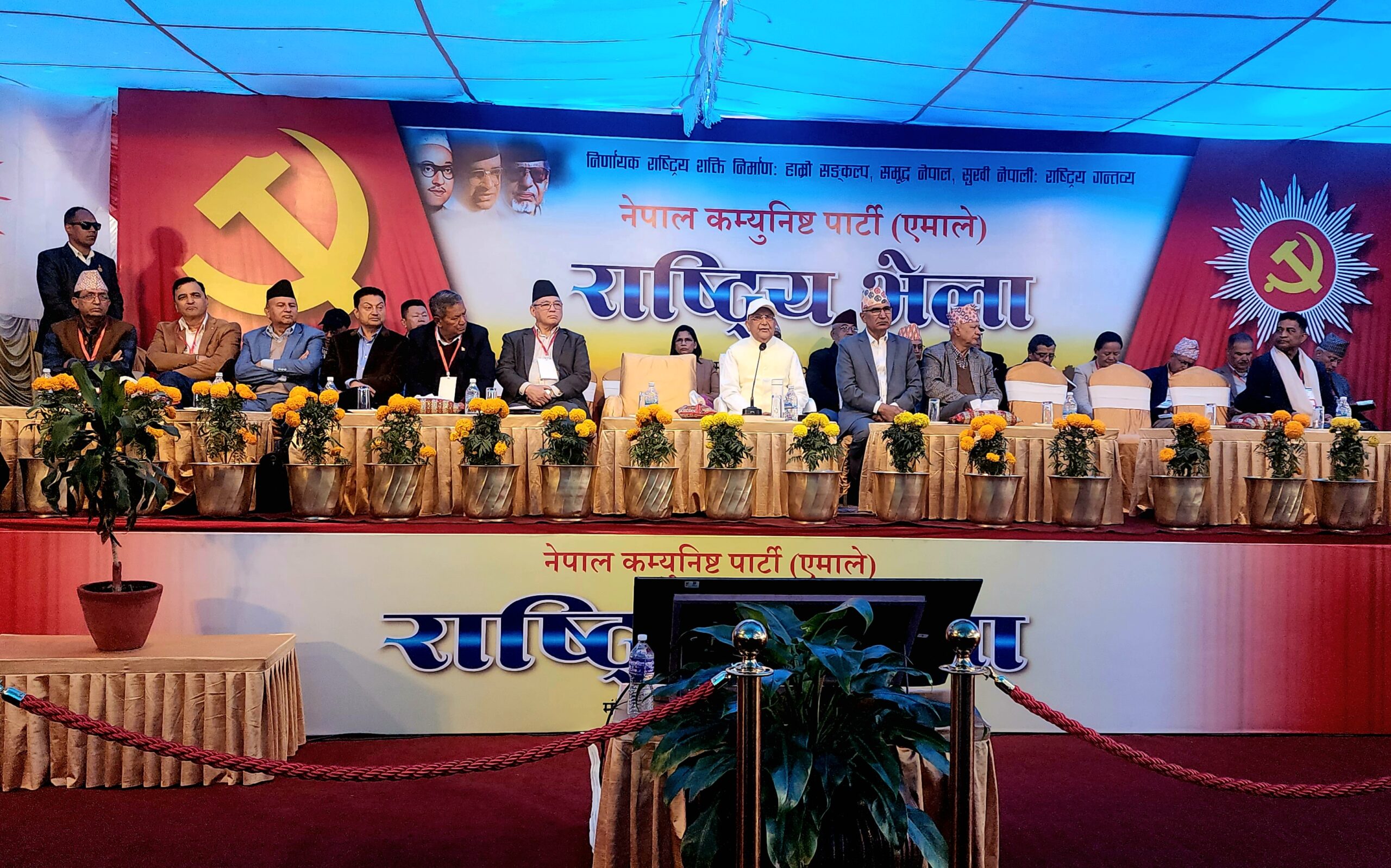
The Party's national cadres' gathering, held in Kathmandu on 18–19 November with the participation of 3,414 representatives from across the country and abroad, set the direction for this work. The gathering adopted a 21-point proposal addressing democracy, national sovereignty, public livelihoods, flood rehabilitation and the Party's organisational priorities. It called for strengthening the Party's structures and preparing for local elections, while declaring its readiness to mobilise if necessary to defend the constitution and democratic processes.
The gathering also highlighted the need for organisational renewal. General Secretary Shankar Pokharel acknowledged that the UML had weakened its relationship with the public and that its grassroots campaigns had not succeeded in establishing effective communication with people's everyday concerns. He called for a campaign to improve the Party's discipline, conduct and public credibility. The Party also discussed measures to reactivate local committees, improve candidate selection and strengthen its use of social media.
While Pokharel has called for changes in the Party's working methods, Chairman KP Sharma Oli has defended the existing leadership and urged cadres to move forward in unity. The gathering postponed the unresolved questions of leadership change and restructuring in favour of concentrating on the coming elections.
The UML continued its grassroots activity during the following week. On 20 November, it held a national gathering of elected local representatives at its central office in Chyasal. On 26 November, the Party announced that more than 400 local leaders and activists from the Nepali Congress and Janata Samajbadi Party Nepal had joined its ranks in Saptari district.
The Party also stepped up its criticism of the government. On 23 November, General Secretary Pokharel argued that the population had not received the economic relief expected from the new administration and was instead facing increasing financial difficulties. The following day, he criticised Prime Minister Balendra Shah's forthcoming visit to India, arguing that Nepal's national interests had not received sufficient attention. The UML has highlighted unresolved questions concerning border disputes, unequal treaties, trade imbalances and other bilateral issues.
Chairman Oli has meanwhile instructed Party cadres to remain prepared for possible street protests against what the UML describes as arbitrary and unconstitutional government actions. The Party has not, however, announced a specific date for a nationwide mobilisation.
Other recent activities included Oli's address to the UML's National Volunteer Force on 22 November, in which he called on its members to devote themselves to serving the nation, society and citizens. On the same day, Party leader Vishnu Rimal addressed the role of think tanks in promoting shared prosperity and cooperation across the Asia-Pacific region.
(Photo: Nepal News)