
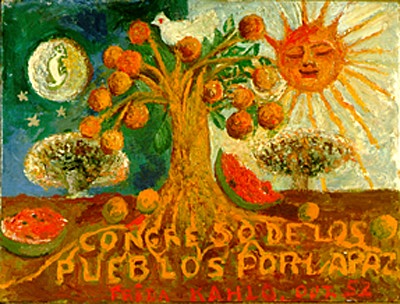
The Communist Party of Mexico (Partido Comunista de México – PCM) has demanded that Frida Kahlo's painting Congress of the Peoples for Peace (Congreso de los pueblos por la paz), created in October 1952, be handed over to the World Peace Council or incorporated into Mexico's national cultural heritage under the protection of the National Institute of Fine Arts and Literature (INBAL).
Communist Party of Mexico demands protection of Frida Kahlo's painting dedicated to peace movement
The party made its position public on 16 November, ahead of the painting's scheduled auction at Christie's in New York on 17 November. The PCM condemned the prospect of a work created in support of the international peace movement being sold to a private collector and criticised the Mexican government's passivity in protecting the painting.
Kahlo created the work in October 1952 as a contribution to the World Congress of Partisans of Peace, which was held in Vienna in December of that year. The painting depicts a white dove perched on a tree bearing the words “Congress of the Peoples for Peace”. It symbolises the international struggle for peace and opposition to war.
Kahlo was herself a communist and regarded her artistic work as part of her political commitment. In her diary, she described her painting as supporting the political line of the Communist Party and referred to her commitment to communism.
PCM calls for the painting to return to the peace movement
In its statement, the PCM argued that the painting should not become another object of private speculation. It demanded that the work either be transferred to the World Peace Council, reflecting its original dedication, or be incorporated into Mexico's cultural heritage through INBAL.
The party's intervention connects the preservation of Kahlo's artistic legacy with the history of the international peace movement. Rather than treating the painting simply as a valuable art-market object, the PCM emphasises its political meaning and the circumstances of its creation.
Christie's withdraws the painting from auction
The controversy acquired a new dimension on 17 November, when Christie's removed the painting from its New York 20th Century Evening Sale, where it had been estimated to sell for between US$2 million and US$3.5 million.
The withdrawal followed requests from Mexican authorities for documentation establishing the painting's provenance and ownership. INBAL's legal department asked Christie's to provide the relevant documents, while the Mexican Ministry of Culture requested that the sale be postponed until the circumstances surrounding the work had been clarified.
The Frida Kahlo Museum also confirmed that the painting was included in an ongoing investigation by the competent Mexican authorities.
The question of ownership and the painting's history remains disputed. The authorities have noted that Kahlo's works were declared artistic monuments in 1984, restricting their permanent export when they were in Mexico at the time. However, the painting had been created in 1952 and sent to the peace congress in Vienna. According to the account presented by Mexican authorities, it left the country before the 1984 declaration. The painting's subsequent ownership history, including how it passed into private hands, has nevertheless raised questions requiring further investigation.
A group campaigning to defend the Gelman Collection has argued that the painting was included in the inventory of Diego Rivera's estate and should be considered part of the legacy left to the Mexican people. The authorities have not yet publicly established all the details of its provenance.
Christie's stated that it had withdrawn the work in agreement with the seller to allow further research, while indicating that it hoped to offer the painting for sale at a later date. Its removal from the auction catalogue therefore does not constitute a final resolution of the dispute.
Art and the struggle for peace
For the PCM, the controversy is not merely about the ownership of a painting. It concerns the preservation of a work created in support of an international movement against war and the defence of its historical and political significance.
Kahlo's Congress of the Peoples for Peace commemorates a period when artists, intellectuals and political activists from different countries sought to unite against militarism and the threat of another world war. The PCM's demand that the painting be returned to the World Peace Council or protected as part of Mexico's cultural heritage reflects its insistence that this legacy should remain accessible and connected to the cause for which it was created.
The withdrawal of the painting from the Christie's auction has opened the way for further examination of its provenance. The PCM continues to demand that the work be protected from private commercial speculation and that its connection with the international peace movement be respected.