
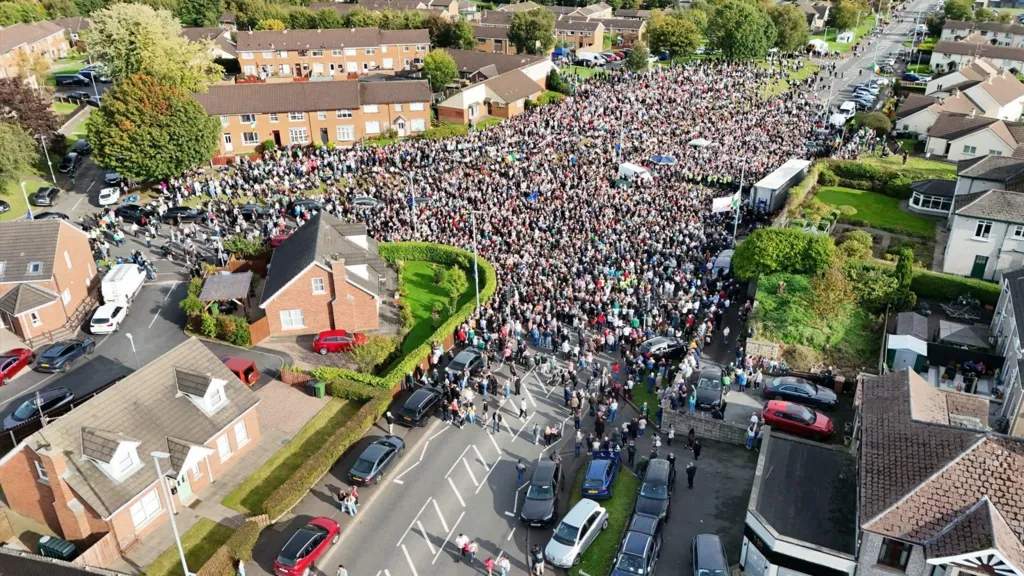

The Communist Party of Ireland (CPI) has welcomed the resistance of residents of Garvaghy Road in Portadown and their supporters, following the British government's decision to prohibit the Orange Order from completing its controversial march through the predominantly nationalist area.
Communist Party of Ireland welcomes resistance to Orange Order March
The party described the outcome as a consequence of sustained community opposition, while stating that the underlying dispute reflects the wider problems of British rule, sectarianism and political division in Northern Ireland.
The controversy escalated on 27 September 2026, when the Parades Commission authorised a restricted Orange Order march from Drumcree Church along Garvaghy Road for the first time in 28 years. The proposed procession was limited to 35 participants, without a band or supporters. Residents and their supporters blocked the route, preventing the march from proceeding. The confrontation subsequently developed into a prolonged stand-off between the Orange Order and the local community.
Following unsuccessful negotiations between the two sides, Northern Ireland Secretary Chris Bryant announced on 9 October that he was revoking permission for the march. He acted after receiving a request from Police Service of Northern Ireland Chief Constable Jon Boutcher, who warned that facilitating the procession could entail a major police operation and an unacceptable risk of serious injury, disorder and wider unrest.
In its statement published on 12 October, the CPI saluted the people of Garvaghy Road and acknowledged the support they received from sections of the Protestant community. The party stressed that the Orange Order does not represent all Protestants, highlighting the possibility of solidarity across communal divisions.
The CPI argued that the government's decision should not be regarded as a victory to celebrate, but rather as a symptom of the failure of the political system in Northern Ireland. It identified British occupation and colonial rule as the fundamental causes of the Drumcree dispute and characterised the Orange Order's insistence on marching through communities opposed to its presence as an expression of sectarian politics rather than a straightforward defence of Protestant culture.
The party also called for a thorough and independent investigation into the original decision to authorise the procession, raising questions about the conduct of both the Parades Commission and the police. It criticised the three unionist parties for their united defence of the Orange Order, arguing that they had failed to recognise the rights of Garvaghy Road residents and the wider republican community.
According to the CPI, the dispute also reflects the inability of Northern Ireland's political institutions to address the deepening economic and social crisis affecting working-class people. The party warned that these conditions allow sectarianism to be used as an instrument of division, diverting attention from the common interests of workers across religious and communal lines.
The CPI called for working-class unity against capitalism and presented a socialist republic, based on public control and democratic central planning, as the path towards peace and national liberation. It argued that the resistance on Garvaghy Road could provide a starting point for building such unity.
The dispute is not yet legally resolved. On 12 October, the High Court in Belfast adjourned the Orange Order's challenge to the government's ban until 19 October. The legal proceedings have also been expanded to include the PSNI chief constable's role in requesting the intervention. The case is therefore set to remain a significant development in the continuing political dispute over parades, community rights and the legacy of sectarian division in Northern Ireland.
(Photo: Aodhán Roberts)