
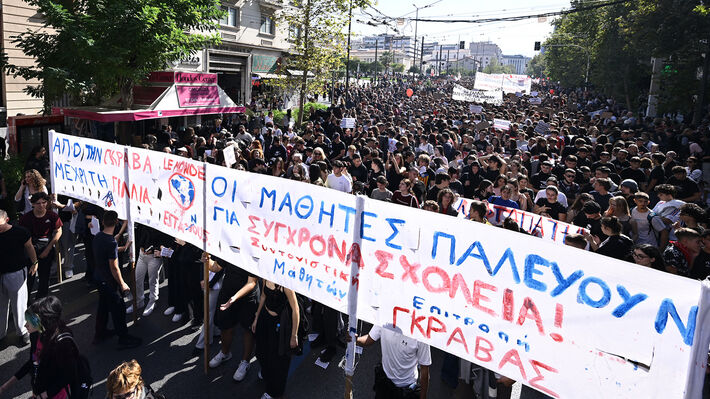

The Communist Party of Greece (KKE) and its youth organisation, the Communist Youth of Greece (KNE), welcomed the mass demonstrations held across Greece on 21 October, when tens of thousands of school students, university students, teachers, parents and workers took to the streets demanding better public education, safer schools and measures to address the rising cost of living.
KKE and KNE support mass education protests across Greece
KNE described the demonstrations as a mass expression of young people's demands to receive a comprehensive education free of charge and in safe conditions, while being able to study and live with dignity. It highlighted the slogan, “Will we study or survive?”, which it said captured the financial pressures facing students and their families.
The protests raised concerns about inadequate school infrastructure, staffing shortages and the cost of education and student life. Teachers' demands included higher pay, the filling of vacant posts, permanent appointments for substitute teachers and greater state funding for safe school buildings. Students also called for improved access to affordable accommodation and better conditions for studying.
KNE placed particular emphasis on the Grava school complex in Athens, one of Greece's largest school complexes, where serious concerns had been raised about the condition and safety of facilities. In a separate report, 902.gr highlighted the confirmation of significant problems at the site. KNE argued that the state was treating student safety as a cost rather than a basic responsibility.
KNE links the mobilisation to wider social and political issues
KNE presented the demonstrations as part of a broader struggle against policies it believes prioritise corporate profits and military spending over social needs. Its statement contrasted what it described as insufficient funding for education and healthcare with the resources allocated to NATO military equipment and business interests.
The organisation also connected the Greek protests with youth mobilisations in France. Its slogan, “From Greece to France, across Europe we are making history!”, expressed its view that young people in different countries face related problems, particularly the rising cost of living and barriers to education.
KNE argued that collective organisation and mass action could challenge attempts to discourage student mobilisation through threats and repression. It described the demonstrations as an important starting point for strengthening solidarity and collective action. These assessments reflect the political position of KNE, rather than independent findings about the government's intentions.
Further action announced for 30 October
KNE announced 30 October as the next major date of mobilisation, calling for new school-student and university-student demonstrations. It linked the planned actions to an international day of dockworkers' struggle involving more than 100 ports worldwide.
The organisation called for the demands of students and workers to converge around education, employment, living standards and peace, opposing wars that it characterises as serving capitalist interests.
For KKE and KNE, the 21 October demonstrations were therefore not simply protests over conditions in schools and universities. They were also presented as part of a wider struggle over public spending, young people's prospects and the priorities of government policy. The party and its youth organisation intend to continue mobilising around these issues, with 30 October identified as the next major occasion for action.
(Photo: 902.gr)