
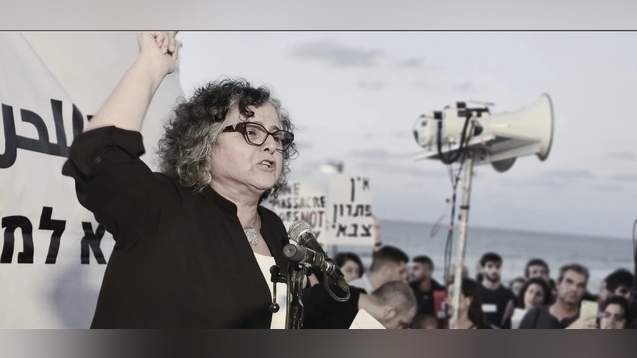
Member of Knesset Aida Touma-Suleiman, who is a long time and preeminent member of the Communist Party of Israel, has decided to retire from the parliament after almost 12 years as a MK representing Hadash. Zo Khadarek, journal of the Party, spoke with her about her past path, achievements and disappointments, political challenges and her plans for the future.
Communist Party of Israel MK leaves Knesset after 12 years
After 12 years, your term in the Knesset is coming to an end. What is your assessment of this?
Earlier this week, we were informed that the plenary session would start earlier than usual and continue continuously until Friday. This would be a week of last-minute legislation, a kind of "table clearing." The government would try to push through as many bills as possible that were still on the agenda .
These are dangerous and bad bills. I am very afraid that they will try to ratify significant budgetary decisions, for example decisions regarding budget cuts for Arab society and transferring the amounts to the Shin Bet. This week is technically busy, in terms of the number of laws being tried to be approved, but also busy in terms of the severity of the laws and the danger they pose .
The Netanyahu government is striving to establish as many facts on the ground as possible. Even if there is a change and another government is formed after the elections, it will be very difficult to deal with the scope of racist and anti-democratic laws that the right-wing government is leaving behind. I very much hope that we will succeed in overthrowing this government in the upcoming elections. But we must understand that even when this happens, hard work will be required to change the created reality .
Personally, I am very happy with the decision not to run for the Knesset again. Unfortunately, the Knesset and the country are in a difficult time and our work is mainly focused on containment and protection, rather than on promoting the things we would like to promote. In the last four years, we have invested a lot of energy in protecting our basic values. You look around you and realize that you have almost no partners in the Knesset for the things you want to promote. This strengthened my decision to leave .
But as the date approaches, there are of course additional emotions. I am summarizing almost 12 years and what I have managed to advance and what I have not managed to achieve. The last four years have been particularly difficult. I have witnessed up close the war, the genocide, the loss of much of the hope that things can be fixed. It is a very difficult experience. It is also difficult to say goodbye to friends and partners with whom I have come a long way over the years. In any case, I am not leaving the field and I am not retiring. I will wage a different kind of struggle. Now is a period of transition, and also a period of soul-searching .
What are the achievements you are most proud of?
There are several laws that I am very proud of having been able to pass. One of them is the electronic handcuffing law, which is designed to protect women who are in danger, and to allow them to try to live as normal a life as possible, instead of the only solution being to move them to closed places or shelters. I am not against shelters, it is important for me to say this. But electronic handcuffing is another important tool for protecting women's lives, as it limits the attacker and not the woman. Another law that is very important to me is the one that requires the courts to check whether a violent person deserves treatment, and to send him to treatment.
I am also proud of the law on the criminalization of prostitution. In my opinion, this is a very important law, because it changes the perspective: not the criminalization of women in prostitution, but the criminalization of the actual consumption of prostitution. Another thing I am very proud of is the Law on the Authority to Combat Poverty. I hope that in the future this authority will operate as we intended from the beginning – not as a place of standards and jobs, but as an authority with powers and a real action plan to combat poverty. The fight against poverty should be at the level of policy, not at the level of philanthropy. In addition, I am very proud of the fight I waged against occupational accidents. This is an issue that I worked very hard on. I was the only member of Knesset who was present at all the discussions leading up to the approval of the new safety regulations.
What things do you think are essential to look different?
Unfortunately, it is about too many things. I have seen how the Knesset is becoming a place that fulfills the will of the coalition and its leader. I have never seen the Knesset as the embodiment of democracy, but it has lost even more of the status it once had. Many of the parliamentary tools have been taken from the hands of the Knesset members. The Knesset has largely become a kind of show for the public, instead of a place of real and serious work.
We also saw how an opposition can become a safety net for the government, when it stands behind the policy of war and oppression, instead of presenting a real alternative. In the past, there was more room for maneuver in the Knesset. For seven or eight years of my tenure in the Knesset, I was the chairman of a committee – the Committee for the Advancement of the Status of Women, and during the transition period, I was also the chairman of the Labor and Welfare Committee, which worked on several important issues at the beginning of the coronavirus pandemic. These were significant tools for parliamentary work. In the current Knesset, we were almost never granted questions and motions of order, which are central tools in the work of every Knesset member.
We witnessed real attempts to harm any possibility of our serious work. This was also reflected in the Ethics Committee, in the decisions that were made, and in the way they prevented us from speaking out. I was suspended from the Knesset for two months, and then for another two weeks. Other members of the faction were also suspended. It was clear that they were trying to prevent us from functioning in the Knesset, and in the most sharp and effective way possible. I will have to sit down and write about this harassment in a systematic manner, it is important that this harassment be documented.
Therefore, in my opinion, the change must start at the base, cosmetic change will not be enough. Without a real struggle against the occupation, there will be no real correction. Israeli society has tried to escape from the most burning issue, which is the foundation of most of the problems we face: the occupation, the oppression of another people, the annexation policy and the perpetuation of the idea of Jewish supremacy. These perceptions have taken root in Israeli society. Therefore, we need to be on the ground, organize and fight .
Over the years, you have been strongly identified with the feminist struggle and the advancement of women's status. In today's Israel, has the status of women been strengthened or are we in the midst of a retreat?
I believe that we are witnessing a very strong regression. I am not claiming that the status of women in Israel was perfect before. But within the liberal framework that existed, women managed, through a very stubborn struggle, to achieve many things. Unfortunately, already at the beginning of the current term, I predicted that there would be a regression in the status of women. I warned against it, and the Knesset did not like it. They thought that I was speaking from my oppositional position, or from an Arab-Palestinian position, more than as a feminist who knows how to read political reality. But the reality was clear: as soon as there are ultra-right forces in power, and when fascism is rampant and religious coercion takes over every good part of it – this is a clear formula for regression in the status of women in all areas.
Legislation that imposes religion in the public sphere harms women first and foremost. This is expressed in the militarization of society, which escalated even more after October 7. I hear women celebrating the expansion of military service for women, as if the fight against the ultra-Orthodox is about increasing the number of women in the army. They do not ask what such a move means. But what kind of equality is it to integrate women into an anti-feminist value system, a system that sanctifies violence, control, oppression, killing and murder? In what way do you want to be equal to men: in the ability to bomb? To participate in genocide? Is that the equality you want? Is that feminism? In my opinion, this indicates a deep confusion. Some of the women in the coalition and opposition who define themselves as feminists have been revealed as being closer to the world of values of Limor Son Har-Malech's nationalist right than to feminism that is essentially a lover of peace and justice .
The understanding of the concept of "women's sisterhood" has also been damaged. Women's sisterhood is supposed to be the fruit of understanding all levels of oppression, and to express standing with the oppressed. Women's sisterhood is distorted when it is presented as an expression of nationalism. Without seeing the other, it is not women's sisterhood and it is not feminism - it is nationalism. In my opinion, the feminist movement should be more alert to this distortion, the results of which we are now witnessing.
As expected, this shift is also reflected in legislation: expanding gender segregation in academia; expanding the powers of religious courts; legislation regarding sex offenses on nationalistic grounds, and other initiatives that harm women's rights . Beyond legislation, the mere exclusion of women from decision-making positions causes damage that will take a long time to repair. In the public service, in government offices, and in private companies, the atmosphere is chauvinistic. When militarism is strengthened, it also seeps into civil society and the public service .
For example, all the decisions that give priority to reservists and combatants – no one has examined what they mean for women. How will this affect their employment? How will this affect their promotion in the workplace? Even if we don't see the consequences immediately, we will see the results in the coming years .
How do you maintain hope in such a difficult and frustrating reality?
First of all, you have to insist on remaining human. Humans can lose hope, and there are moments like that. But in my opinion, losing hope is less difficult than losing humanity. You can recover from moments of loss of hope. But someone who lost humanity during this period – I don’t know how they will recover .
On the one hand, there is great pain in the heart. We have seen, heard and experienced very difficult things. We have heard people who we thought might realize in the moment of truth that they were leading both peoples to disaster, and instead we have seen them supporting war, indiscriminate bombing, a policy of killing and destruction. These are scars that we carry with us. On the other hand, we have seen people who are enlisting despite the pressure, the slander and the personal cost. People who are willing to stand up and defend the democratic regime. We are not the majority, and our situation is difficult, but the public campaign signals hope that we can still change reality .
What is Hadash's main challenge ahead of the upcoming Knesset elections?
The main challenge is to get people to the polls – mainly in the Arab public, but also in the democratic Jewish public. We must contribute a high voter turnout that will give us power. First of all, to overthrow this fascist government; and secondly, so that we can become an influential force through it, even if we are in opposition. There are many on the left today who do not have a political home. All kinds of Zionist parties are trying to convince them that they have a home with them. We must remind them: these parties still support the war and the occupation. If they have criticism, it is usually criticism of Netanyahu for not “finishing the job,” not criticism that presents a real alternative .
We must reach the politically homeless and try to convince them that if they really want to be as far away from the fascist government as possible, their home is Hadash. Anyone looking for a political force that will fight the fascist government, or a "national unity government" that could lead to the same results and also the policies that have degraded us to this point – their address is Hadash. We must convince additional circles in the public to see us as the true address against the right-wing government and its policies. In Israel, there are always those who believe that the general who participated in the wars is the one who will bring a solution. But the general will not bring a solution.
What are your plans for the day after the Knesset after years of such intense work?
In the formal sense, the day after the Knesset is the date when the new Knesset will be sworn in and a new government will be formed. Until then, I am fighting together with my colleagues to achieve everything I talked about – strengthening Hadash, getting people out to vote, changing the balance of power. I do not yet have a solid personal plan for the day after. But one thing is clear to me: I am not leaving the struggle. I recently recalled an interview I gave to Radio A- Shams on November 2, 2022, the day after the last elections. I was asked what I thought about the election results, and I said that they were catastrophic results.
I estimated that the arena of parliamentary struggle would be reduced and that the most important struggles would be the popular struggle and the international struggle to exert pressure. I believe that I have never been as sober as in that interview. It is clear to me that with the cessation of my activity in the parliamentary arena, I will devote my energy to action in the other two arenas: the popular arena and the international arena. That is where I want to continue to operate.