
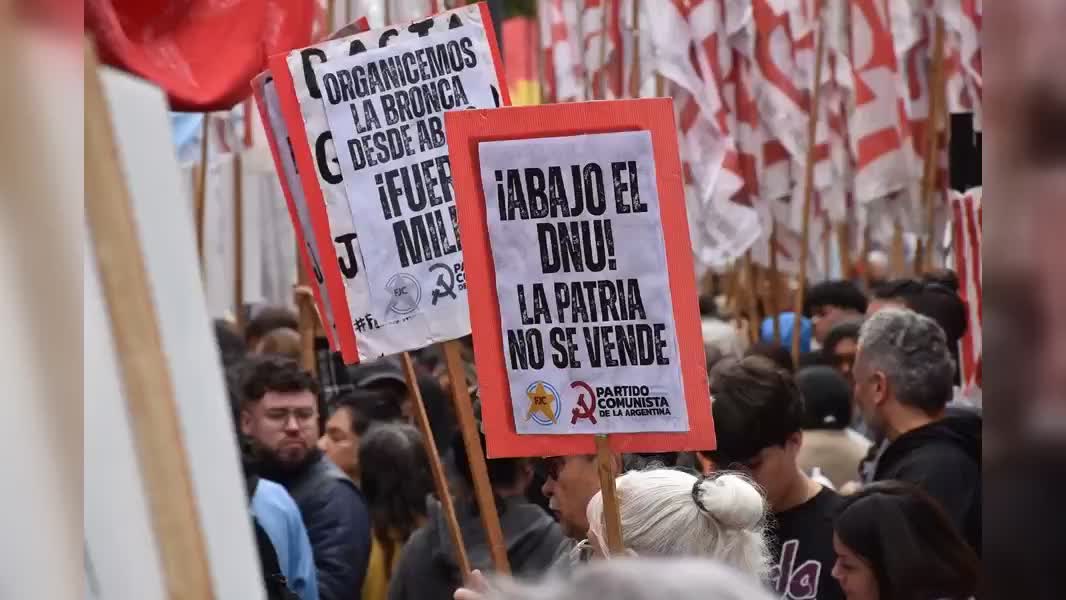
The Communist Party of Argentina (Partido Comunista de la Argentina, PCA) participated in protests against the Supreme Court’s decision concerning restrictions on foreign ownership of rural land.
Communist Party of Argentina joins protests against foreign land ownership
On 6 October, social, trade-union and political organisations, together with Malvinas War veterans, gathered at Plaza Lavalle in Buenos Aires, facing the courthouses, to oppose the removal of legal protections limiting foreign ownership of Argentina’s rural territory.
The protests followed the Supreme Court’s 29 September decision, which overturned an earlier ruling blocking the effects of Article 154 of President Javier Milei’s emergency decree, DNU 70/2023. The article repealed Argentina’s Rural Land Law, Law 26,737, adopted in 2011. The law had limited foreign ownership of rural land to 15% nationally and in each province and department, while imposing additional restrictions on individual holdings.
The PCA joined the mobilisation alongside social movements, trade unions, other political organisations and Malvinas veterans. Its intervention framed the issue as a defence of national sovereignty and popular democratic rights against the government’s deregulation programme and the influence of foreign capital.
The Communist Party’s Statement
Following its participation in the protests, the PCA issued a statement condemning the Supreme Court and the Milei government. The party argued that decisions affecting the country’s future should be made by the people rather than imposed by judicial institutions. It also criticised Congress for complicity through action or inaction.
The statement declared:
“We took over Plaza Lavalle—facing the courthouses—alongside social, union, and political organizations and Malvinas veterans, because in a true democracy, it must be the people who decide their own destiny, not a judicial caste deciding for us.
We cannot wait for the elections while, day by day, they sell off the homeland and starve us to death.
We cannot rely on the Supreme Court or Congress—complicit through action or inaction in this national tragedy—to uphold our rights.
Let us keep organizing our outrage from the grassroots. Let us keep uniting our struggles in the streets.
On October 15, with the people united and mobilized across the country, the fight continues to enforce the University Funding Law and to overturn the ‘Mega-DNU’ that allows this sell-out, impoverishing government to deepen austerity measures and the looting of the nation.
Because the Homeland is not for sale. Because our sovereignty and our rights are not up for negotiation.
Out with the Court!
Out with Milei!”
The statement links opposition to the removal of land-ownership restrictions with resistance to austerity, the defence of public education and opposition to the broader package of deregulation introduced by the Milei administration. Rather than treating the land dispute as an isolated legal question, the PCA presents it as part of a wider political struggle over national resources, democratic accountability and the distribution of economic power.
From the Land Dispute to the 15 October Mobilisation
The PCA called for continued grassroots organisation and the unification of struggles in the streets. It specifically highlighted the planned nationwide mobilisation on 15 October, centred on enforcing the University Funding Law and overturning DNU 70/2023.
The reference to the “Mega-DNU” reflects the party’s opposition to the extensive deregulation measures introduced by Milei’s emergency decree. By bringing together the questions of land ownership, university funding and austerity, the PCA sought to connect different social constituencies around a common opposition to the government’s economic programme.
The party’s appeal also rejected the idea that the struggle should be confined to electoral politics or legal proceedings. Its statement argued that sustained popular mobilisation was necessary to defend social rights and national sovereignty.
Legal Developments
On 9 October, the Supreme Court provisionally suspended the effects of Article 154 of DNU 70/2023 in a separate legal proceeding, temporarily restoring the protections established by the Rural Land Law while the case continued. This was an interim measure rather than a final ruling on the constitutionality of the repeal.
The development changed the immediate legal situation but did not settle the wider political dispute over the decree or the government’s deregulation programme.