
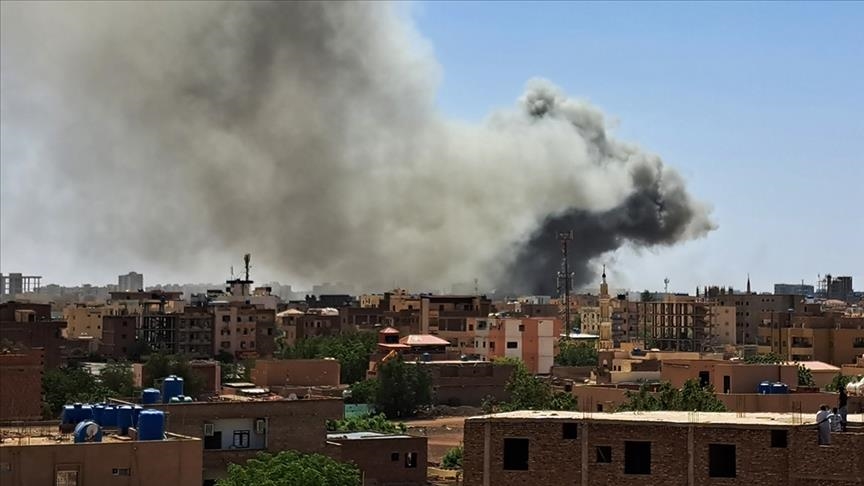

Since the beginning of the current civil war in Sudan, the country has been divided. External forces like Egypt, UAE and Israel are intervening in this chaotic situation. The Sudanese Communist Party recently published an article about the prospects of people's power in the Party publication Al-Midan.
The Road to Ending the War and Reclaiming the Revolution
The war in Sudan is witnessing increasing complexities that cannot be understood in isolation from the scale of external interventions, which have transformed the conflict from an internal crisis into an arena of regional and international competition. Since the outbreak of the fighting, numerous external initiatives and conferences have emerged, promoted as pathways to a solution; yet in reality, they have failed to stop the bloodshed. Some have even contributed—directly or indirectly—to prolonging the war.
The conferences held in various capitals carried attractive titles: ceasefire, protection of civilians, support for political transition. However, these platforms lacked two crucial elements: genuine political will and the representation of revolutionary popular forces on the ground. Many of these initiatives were shaped by the calculations and interests of the sponsoring states—whether related to geopolitical influence, resources, or the reshaping of the balance of power in the region. Thus, some of these meetings became merely diplomatic façades that do not address the root causes of the crisis, but rather manage it in ways that serve specific parties.
In contrast, forces of political Islam—especially those linked to the former regime—and armed militias have played a clearly destructive role in fueling the war. These forces, which lost power as a result of the popular revolution, have not abandoned their project. Instead, they have sought to reproduce themselves by feeding the conflict, infiltrating institutions, and promoting a discourse of polarization and division. They have found in the war an opportunity to return to the scene, even if the price is the tearing apart of what remains of the state and social fabric.
The continuation of the war in this manner reveals a deep crisis in the structure of the proposed solutions. The conflict cannot be ended through top-down arrangements formulated outside the country, while the forces that made the revolution and sacrificed so much are marginalized. Experience has shown that any peace process that does not emerge from within, and is not based on an organized popular base, is doomed to fail or be circumvented.
From this perspective, the unity of the ranks of the revolutionary forces emerges as a fundamental condition for escaping the cycle of war. Fragmentation and divisions among the components of the revolution have weakened their ability to influence events and have opened the door for counter-revolutionary forces to fill the vacuum. What is required today is not merely temporary coordination, but the construction of a broad grassroots front based on resistance committees, trade unions, the Radical Change Alliance, civil organizations, and all forces of genuine change.
This front is not an elite alliance, but a mass political project that restores power to the people and lays the foundations of a democratic civil state. It is a front capable of imposing an agenda of just peace, ending the war, holding those responsible for crimes accountable, and dismantling the structures of the old regime that continue to fuel the conflict.
The path to ending the war in Sudan does not pass through hotel conference rooms abroad, nor through reproducing the framework agreement, but through the Sudanese street itself—where the revolution began, and where it can be completed. The unity of revolutionary forces and the building of a grassroots front are not tactical options, but a historical necessity to save the country from collapse and to open a new horizon toward freedom, peace, and justice.