
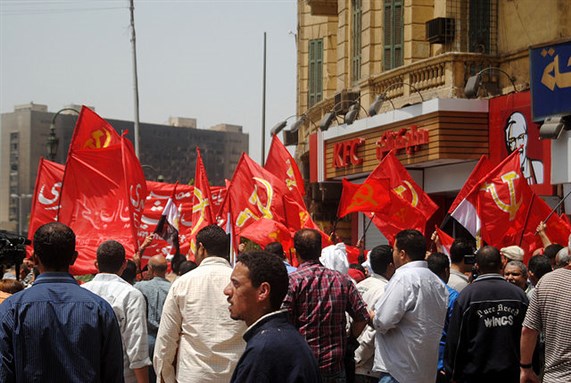
Salah Adly, former general secretary of the Egyptian Communist Party wrote an article on the 30 June Revolution at its 13th anniversary. The article, entitled "The Role and Position of the Communist Party in the 30 June Revolution" was published on the Egyptian website Al-Hiwar Al-Mutamaddin.
Egyptian Communist Party reflects on 30 June Revolution
On the thirteenth anniversary of the June 30 Revolution, I find it an appropriate occasion to record a testimony on the role of the Egyptian Communist Party in confronting the authoritarian rule of the Muslim Brotherhood.
Even before the outbreak of the January 25 Revolution in 2011, the Egyptian Communist Party's position was clear and publicly declared. It was set out in the report of the Party's Central Committee issued in 1989, adopted by the Party's Third Congress in 1992, and remained unchanged through the January Revolution and its aftermath.
At the time, however, the opposition was divided. Some sided with the Mubarak regime under the pretext of confronting the Muslim Brotherhood, while others allied themselves with the Brotherhood, considering it the force most capable of overthrowing the regime. Between these two positions, the Egyptian Communist Party maintained its independent stance, rejecting both the authoritarianism of Mubarak's regime and the religious authoritarianism of the Muslim Brotherhood.
Before the presidential election that brought Mohamed Morsi to power, the Party, together with a number of national forces, opposed all the measures and decisions that paved the way for the Brotherhood's control over the institutions of the state. It consistently warned against the dangers of the political Islamist project in all its forms, including the Muslim Brotherhood itself, the parties and movements that emerged from it—such as the Strong Egypt Party, the Wasat Party, the Hazemoun movement—and the Salafist current represented by the Al-Nour Party and others.
For this reason, the Party refused to participate in the well-known Fairmont meeting, where public figures from numerous political forces sought to influence Mohamed Morsi or obtain commitments from him to respect democracy and the principles of the civil state, relying on his promise to honor any agreements reached. Subsequent events, however, proved the Party's position correct, as Morsi and the Brotherhood abandoned all the commitments made at the time. This both exposed the Brotherhood's true position and prompted many participants in that meeting to reconsider their own stance.
As the Brotherhood increasingly resorted to violence, incitement, and reliance on its militias and affiliated organizations, the Egyptian Communist Party took part in all mass activities opposing Brotherhood rule.
One hundred days after Morsi assumed office—the period he himself had requested, saying, "Judge me after one hundred days"—that judgment came in the first major demonstration against his rule, called by the Egyptian Communist Party, the Egyptian Socialist Party, and the Popular Socialist Alliance Party.
The demonstration, which began in Sayyida Zeinab Square and headed toward Tahrir Square, was violently attacked by Brotherhood militias upon reaching Mohamed Mahmoud Street. Protesters were pelted with stones and beaten with clubs, resulting in numerous injuries.
These events exposed the violence and intimidation that the country could expect from the Brotherhood and its militias, which were trained in various forms of violence and terrorism.
The author also recalls the Brotherhood's siege of a large sit-in outside the Presidential Palace in Heliopolis, where demonstrators were protesting Morsi's constitutional declaration, which they believed entrenched his absolute dictatorial authority, reinforcing Khairat al-Shater's statement that "we will rule you for five hundred years." The sit-in was met with severe violence that left several people dead, dozens injured, and many protesters abducted and tortured in the vicinity of the palace. The media also documented the assault on Shahenda Maklad, a leading member of the Egyptian Communist Party, whose attackers failed to silence her as she continued chanting, "Down with the rule of the Supreme Guide."
The idea of demanding early presidential elections was subsequently discussed at a meeting held at the Tagammu Party headquarters, attended by representatives of left-wing parties and public figures. The proposal was accepted by all participants, who agreed that the best way to mobilize public support would be through a nationwide petition calling for early presidential elections within a specified timeframe.
This led to the launch of the Tamarod ("Rebel") movement, which the Communist Party strongly supported. Party members actively participated in collecting signatures, and millions of Egyptians from across the country signed the petition, turning Tamarod into a genuine expression of the popular will against continued Brotherhood rule.
The National Salvation Front was then established, with the participation of the Communist Party. It brought together virtually all Egyptian political parties except those representing political Islam. The Front played a central role in exposing the Brotherhood's practices, providing strong political support for the popular protest movement, contributing significantly to the Tamarod signature campaign, and later supporting the Roadmap announced on July 3.
The demonstrations continued until millions of Egyptians took to the streets across the country on June 30, 2013, demanding the downfall of Brotherhood rule and chanting, "Down, down with the rule of the Supreme Guide." According to the author, the demonstrations reflected the overwhelming popular will of approximately thirty million Egyptians, in addition to millions of others who supported the movement but were unable to participate.
What occurred on June 30 was a genuine popular revolution based on the largest mass mobilization in modern Egyptian history, and the intervention of the armed forces came in response to the people's demands and to protect the state from collapse.
June 30 was a revolution supported by the army, not a military coup, contrary to how it was portrayed by the United States, various governments, and much of the international media. The Muslim Brotherhood's organizations abroad played a major role in presenting the events as a coup against democracy and legitimacy.
To counter this narrative and present what it regarded as the true nature of the Egyptian people's revolution against the Brotherhood, the Egyptian Communist Party, together with several left-wing parties, organized—with the assistance of the Cuban Embassy and in coordination between the Tagammu Party and the Egyptian Ministry of Foreign Affairs—a meeting attended by thirteen ambassadors from Latin American countries. According to the author, this meeting helped clarify the reality of the June 30 events and contributed significantly to correcting perceptions shaped by the Western media.
The Communist Party also participated in numerous conferences organized by communist parties around the world and sent statements and messages explaining its interpretation of the June 30 events to more than ninety communist and workers' parties internationally.
The June 30 Revolution cannot be understood in isolation from the January 25, 2011 Revolution. Without January 25, June 30 would not have occurred. For this reason, we reject attempts either to glorify June 30 while denigrating January 25 and blaming it for Egypt's current problems, or to portray June 30 itself as the source of those problems or as a military coup. Instead, the Party views June 30 as a popular revolution and an important stage in Egypt's national democratic revolution.
At the same time, June 30 is a revolution that was ultimately betrayed and left incomplete. It failed to achieve any of the goals of the January Revolution because the current government adopted policies contrary to the interests and needs of the overwhelming majority of Egyptians, particularly in education, healthcare, living standards, freedom of expression, and the right to choose political representatives without intimidation or tutelage. Rather than expanding democracy, the authorities have closed democratic space to an unprecedented degree in modern Egyptian history, while large numbers of prisoners of conscience remain imprisoned on what are described as routine and pre-prepared charges.
Nevertheless, despite remaining unfinished, June 30 remains a great revolution because of the millions who participated and because it dealt what is described as a crushing blow to the Muslim Brotherhood, preventing it from reviving its political project or returning to power. History will record the June 30 Revolution as a decisive contribution by the Egyptian people to protecting both the region and the wider world from the spread of terrorism that would have become far more difficult to eradicate had the Brotherhood succeeded in consolidating its rule over Egypt.