
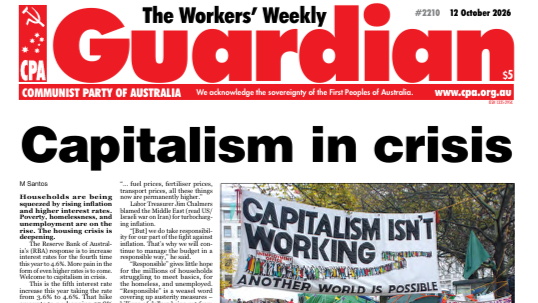

The following article was published in the 2210th edition of the Workers' Weekly Guardian, the newspaper of the Communist Party of Australia. Written by M. Santos, the article criticises the policies of the Reserve Bank of Australia and proposes anti-inflationist measures that support the interests of ordinary people.
Communist Party of Australia: Capitalism in crisis
Households are being squeezed by rising inflation and higher interest rates. Poverty, homelessness, and unemployment are on the rise. The housing crisis is deepening.
The Reserve Bank of Australia’s (RBA) response is to increase interest rates for the fourth time this year to 4.6%. More pain in the form of even higher rates is to come. Welcome to capitalism in crisis.
This is the fifth interest rate increase this year taking the rate from 3.6% to 4.6%. That hike amounts to a whopping 27.8% increase in interest costs. The banks responded within hours of the announcement raising interest rates on home loans.
Personal insolvencies are on the rise. Since interest rates started to increase, an additional 200,000 people are out of the paid workforce.
As for the resultant fall in housing prices, it brings little joy to those who recently took out a mortgage or to vendors watching the housing bubble begin to burst.
“All households’ budgets have been affected by high inflation eroding purchasing power,” the RBA’s September Financial Stability Report said.
The report stated the obvious: “… this is more likely to cause stress for lower-income households, many of whom are renters, because their expenses tend to make up a larger share of their disposable income.”
According to RBA Governor, Michele Bullock, the main reasons for interest rate rises are weak productivity growth, excess demand for goods and services compared with supply, and a labour market that is still “too tight.” That means unemployment has not risen enough.
The inflation impulse from the Middle East conflict and the AI boom are in addition to these primary causes Bullock said. She does, however, acknowledge that “… fuel prices, fertiliser prices, transport prices, all these things now are permanently higher.”
Labor Treasurer Jim Chalmers blamed the Middle East (read US/Israeli war on Iran) for turbocharging inflation.
“[But] we do take responsibility for our part of the fight against inflation. That’s why we will continue to manage the budget in a responsible way,” he said. “Responsible” gives little hope for the millions of households struggling to meet basics, for the homeless, and unemployed.
“Responsible” is a weasel word covering up austerity measures – billions of dollars being cut from the NDIS and aged care, and the failure to increase poverty-level JobSeeker and other social security payments. It doesn’t impress those on the receiving end of the housing crisis.
LIVING STANDARDS
When asked if the RBA is prepared to drive the economy into recession in an attempt to bring interest rates down to the Board’s arbitrary target of 2%-3%, Bullock replied: “That is not our central base case at this moment.” In other words, the RBA is prepared to go that far.
“So it’s not our base case, I don’t want it, but if inflation expectations get away, that’s the sort of scenario you might be looking at,” she said in answer to another question.
“We’ll do what we have to do to get inflation down because we need to.”
Bullock admitted that “those who have mortgages, yes, this clearly impacts them and it hurts them. They’ve got less cash flow, and they’ve got less money to spend on things.”
That is the aim of interest rate hikes – to reduce consumption of goods and services.
Workers and their families take a hit with every interest rate rise. So too do those on the lowest incomes such as the unemployed and pensioners.
They are being made to shoulder the burden as the RBA raises their cost of living – a blunt and cruel instrument designed to reduce purchasing power in the name of cutting demand for goods and services.
In the short-term higher interest rates can increase inflation as businesses and landlords pay more to service their debts and pass on higher costs to consumers and renters.
Reduced demand for goods and services leads to redundancies and bankruptcies. Already unemployment is on the rise.
"According to our research, in fact, the most important channel is the exchange rate channel. And raising interest rates impacts import prices.” It attracts investors which increases the value of the dollar, making imports cheaper and “encourages people to spend more on imports rather than domestically produced goods,” says Bullock.
Yet another means of increasing unemployment! Don’t buy Australian-made!
The number of multiple job-holders has risen 6.6% since March 2026 to one million with women being the majority. It’s evidence that the previous cuts are hurting.
The RBA is playing Russian roulette, trying to shrink an economy showing signs of heading into recession.
One of the RBA’s aims is “full employment.” It was originally defined as “Ensuring that as many Australians who wanted to work could find jobs.”
In 2025, the RBA and the Treasurer reached agreement on defining it as the maximum level of employment consistent with low and stable inflation. In other words unemployment could be 5%, 6% or even higher and still be called “full employment.”
AI JUGGERNAUT
The RBA recognises that AI is a contributor to inflation.
Data centre spending is projected to total US$10.3 trillion (AU$15tr) from 2025-2032 according to the Brookings Institution, posing serious risks to global financial markets. Never before has such a massive raising of capital taken place in such a relatively short time.
That is equivalent to almost one third of the US economy (GDP) of close to US$33 trillion and a quarter of the US government’s more than $40 trillion debt which is being fuelled by military spending and loss of income resulting from massive corporate tax cuts.
In addition, the data centre boom is driving up the costs of tech products such as microchips as it creates shortages for other uses including military, electric vehicles, computers, and mobile phones.
As they struggle to turn a profit in these early years they face competition from Chinese AI, far cheaper for consumers and already proving highly profitable.
The US economy (government, households and corporate sectors) is not the only one burdened by debts and rising interest repayments. Global debt reached a record-shattering US$365 trillion in early 2026.
DEBT BUBBLE
Most governments across the globe are wallowing in debt.
That debt has to be serviced with rising interest rates putting pressure on available and shrinking available capital which in turn drives interest rates even higher. The main drivers of rising debt are AI, military spending, and tax cuts.
This has all the makings of a financial crisis the likes of which have not been seen since the Global Financial Crisis of 2007-2009 or deep recession as governments pursue austerity measures.
Add to that reports of booming stock markets and you have a toxic mix increasing the likelihood of an impending global crisis.
As governments renew bonds (borrowings) at higher interest rates they compete for a finite pool of capital. The Morrison government borrowed heavily during the peak of COVID issuing short-term bonds when the official cash rate was 0.5%.
As those bonds are renewed, interest rates are around ten times higher.
POLICY
The RBA has been tasked with keeping inflation between 2% and 3% but its limited powers, adjusting interest rates, cannot address the causes of inflation.
The government, however, is in a position to reduce inflation at the same time as supporting the interests of ordinary people.
For example, it could:
• Introduce rent and price controls
• Raise unemployment benefits, youth allowance and other social security payments above the poverty line, to a level where recipients can live in dignity and afford necessities
• Slash military spending
• Cut subsidies to fossil fuel corporations
• Regulate the introduction and operation of AI
• Expand the public service, creating jobs
• Nationalise the NDIS, health care, aged care, child care, and utilities.
Nationalisation would remove layers of profit-gouging and make essential services cheaper and universally accessible. The savings from cutting military spending and fossil fuel subsidies could be redirected to public housing programs and public transport.
As Australian Council of Social Service CEO Cassandra Goldie says: “We cannot be certain what the impact of another rate hike now will be on unemployment in a year’s time. An increase towards or above 5% would cause a human disaster, locking people out of jobs for years [...] forcing them to rely on grossly inadequate income support payments.”