
The following article appeared on the 107th issue of O Poder Popular, the journal of the Brazilian Communist Party (PCB). The author, Cheyenne Ayalla, is the political secretary of the Communist Youth Union (UJC).
Image
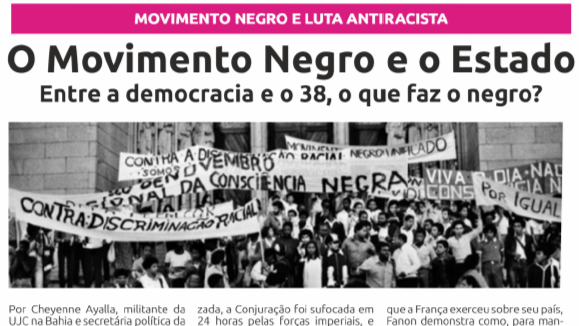
Article by Cheyenne Ayalla on O Poder Popular, the journal of the Brazilian Communist Party (PCB).
Black movement and anti-racist struggle
The national Black Movement took shape in the 1970s. However, its history of mobilization dates back much earlier, to colonial Brazil, with the quilombos — which were the greatest symbol of flight and resistance for the diaspora peoples, as well as for Brazil's native peoples. Zumbi dos Palmares is one of the most emblematic and remembered figures of this period. There are also other important figures who were prominent in the struggle, such as Dandara dos Palmares, Zeferina, Maria Felipa, Aqualtune, and, later, Black intellectuals like Luiz Gama and Luiz Anselmo, who was one of those responsible for creating the Protector Society of the Helpless (1832) — which exists to this day — through which manumissions were purchased and enslaved people were freed with popular support, more than thirty years before the Golden Law (1888).
It is necessary to recall struggles that already presented their character of race and class, such as the popular uprising known as the Bahian Conspiracy (1798), directly influenced by the Haitian Revolution (1791) led by Louverture and others, better known as the Black Jacobins. Although well-organized, the Conspiracy was suppressed within 24 hours by imperial forces, and its main leaders — Lucas Dantas, Manuel Faustino, Luiz Gonzaga, and João de Deus — were hanged and quartered in a public square. To this day, their ossuary remains buried in Praça da Piedade, in the capital of Bahia.
Throughout history, there have also been several moments of intensification and direct armed confrontation of the Black population with the repressive forces of the State, such as the Malê Revolt (1835) or even the Revolt of the Whip (1910), marked by indignation at the physical punishments imposed by their superiors. The bloodiest and most armed struggles of the Black population in Brazil during the colony and the Empire, and even for the emancipation of the nation, end up being ideologically diverted into two narratives: sometimes that of the naturally violent Black person, sometimes that of the Black person beneath their own suffering, stripping it of its character of liberation.
It is worth mentioning what colonization did in Algeria, a theme addressed by psychiatrist and thinker Frantz Fanon, who, after participating in the Second World War and understanding the ills of coloniality, states that the metropolis, the colonizer, sees colonized peoples not as men, but as Black men. Understanding the tutelage that France exercised over his country, Fanon demonstrates how, to maintain its domination, it used ideological ploys, especially in the sense of bestializing the Black person before themselves.
In Brazil, given the republican process, called the Republic of the Swords, several revolts broke out from north to south of Brazil, among which the most emblematic was the War of Canudos, at the beginning of the 20th century, in the Bahian hinterland. The conflict resulted in a slaughter of almost 90% of the population and the death of one of its best-known leaders: Antônio Conselheiro. It was a war marked by the rebellion of the small backlands town and its near-absolute massacre by the Republic, today best known as the Museum-City. The head of the popular revolt leader was taken to the capital as a symbol of victory and preserved for decades at the Old Nina Rodrigues Legal Medical Institute in Salvador (BA).
The first Black organizations
Later on, there was the popularization of both Nazi-fascism and the popular and communist alternative driven by the Russian Revolution and the birth of the USSR. Several organizations began to be influenced by both fascist and communist policies. It is worth mentioning the emergence of the Brazilian Black Front, with conservative ideas and the motto "God, Fatherland, Race and Family," replicating the modus operandi of the conservative parties also present in that period.
In 1930, the PCB launched the presidential candidacy of Minervino de Oliveira — a Black man, a proletarian and militant of the Party, being the only worker candidate in that election. His candidacy raised debates regarding the working class and the starvation wages imposed on the exploited class. During the Vargas period, the Black movement was suppressed, as were several other organizations, and the PCB went underground. In 1945, with the resumption of elections and legality, the new Constituent Assembly allowed the PCB to elect 14 deputies — among them Marighella and Jorge Amado, in addition to a senator: Luiz Carlos Prestes.
Jorge Amado and Marighella presented the Religious Freedom Law (Decree-Law No. 8,921/1946). The persecution of Afro-Brazilian religions was a direct consequence of the ideology of scientific racism, which criminalized not only Afro-Brazilian religions, but also cultural expressions such as capoeira, as it was considered a crime of vagrancy.
With the Military Dictatorship installed in 1964, several movements and parties were once again made illegal. Faced with this scenario, civil rights became an incessant quest. In the 1970s, some movements and resumptions of Black collectives and organized fronts began to emerge in Brazil, greatly influenced by the anti-colonial liberation battles in Africa in the 20th century, with Pan-Africanist and Marxist-Leninist ideological movements, such as the Afro blocks — originating in Salvador-BA, the so-called "Black Rome" — and the reorganization of the Brazilian Black Front, in different molds, removing the fascist aspects present in its first emergence, and adopting the name Unified Black Movement (MNU), to "Defend the Afro-Brazilian community against secular racial exploitation and the human disrespect to which it is subjected" (MNU, 1978).
With the end of the dictatorship and the resumption of the Democratic State of Law, these struggles cooled down and migrated towards interests more aligned with the petty bourgeoisie than with the working class, where access and rights — for a very small portion of the Black population — began to be advocated in an abstract way or within Brazilian legislation — and its limits — without confronting its direct root.
Provocations
The Black movement must rise up in order to question and organize its struggle not around an abstract racism or even directed at empty representations of color and identity, but rather understanding what the Black population suffers from: full employment, labor rights, precarious housing, violence against women, and the daily slaughter of the Black population by the armed arm of the State (the police). From that moment on, there is the illusion that the bourgeois State will defend the interests of the population. One has not yet learned that there is no anti-racist struggle without an anti-capitalist struggle.
The achievements throughout history came from many struggles, with influences from the Black Panther Party in the USA, but, above all, from the struggles in Africa, such as in Nigeria, Angola, Burkina Faso, and South Africa, whose principles were based on the liberation of their peoples from exploitation, therefore, struggles with a class character. However, their main leaders, such as Thomas Sankara in Burkina Faso, were assassinated or, in other cases, wavering sectors were co-opted by capital, leading to a retreat from the radicalized struggle towards a mild social democracy, causing class struggles to be disarticulated or even crushed.
Thus, the time has come to organize the Black movement with its class character, rescuing and orienting itself through national and international struggles. Racism will only fall with the end of the capitalist system and the destruction of neoliberalism and private property. For a freedom that has socialism as its horizon of struggle and Popular Power as its banner.